
A brand mention without a link still has value. Not as a confirmed Google ranking factor, but as a signal that strengthens brand authority and influences how AI models cite it.
For years, marketers looked at link building as if a link were the only currency Google understands. Meanwhile, the search engine has long analyzed what happens without a hyperlink too: the mere presence of a brand in content. In this article, I break brand mentions down to their fundamentals: what they actually are, how they differ from a link, how Google reads them, how AI models use them, and when it is even worth ordering them.
What is a brand mention?
A brand mention is any occurrence of a company name, domain, or product in an article's content that is not a clickable link. A sentence in a guide, or a reference in an expert piece where the author points to a specific solution by name, is exactly what a natural mention looks like.
The difference from a link is simple. A link takes the user to a page and passes on part of what is known as link juice. A mention does not lead anyone anywhere. It builds the context in which a brand exists online, and how often, and in what company, it appears.
A mention does not need to take the form of the full name with a domain extension. Google and AI models also recognize variations: a shortened company name, a flagship product name, or a domain without “.com”. What matters is the semantic context around the name, not the exact spelling.

Mention vs. link: the basic difference
| Criterion | Link | Mention |
|---|---|---|
| Clickable for the user | Yes | No |
| Passes link juice | Partially, depending on the attribute | No |
| Risk to the link profile | Higher with unnatural anchor concentration | Does not affect the link profile |
| Signal to Google | Direct, via the href attribute | Contextual, but not confirmed as a ranking factor |
| Typical context | CTA, referral to a target page | Recommendation, example, expert citation |
From the reader's perspective, the difference is often invisible, and that is the whole point. A mention does not take the form of a link, so the reader perceives it as a natural part of the text, not a sponsored element. Google does not treat mentions like links in ranking terms, which I explain in the next section.
How does Google interpret mentions without a link?
Behind this idea is the term implied links. The name comes from a Google patent tied to the Panda algorithm, which years ago described how brand mentions without a hyperlink are handled. The SEO industry cited this patent as proof that mentions work like links.
In practice, things look different: a close reading of the patent shows that the implied links it describes refer to brand mentions in search queries, not on websites. Asked about this directly, John Mueller from Google said in 2021 that brand mentions are not taken into account when evaluating links or building a site's link graph.
Gary Illyes, at Brighton SEO in 2017, pointed out that highly-cited content online is not just about links, but also mentions on social networks and how people talk about a brand. This is not a declaration that mentions are a ranking factor, but a clear signal that Google looks beyond link structure alone.
In practice, what actually works comes from the search engine's shift toward entities: Google identifies a brand as an entity in its Knowledge Graph and builds its profile based on the contexts in which it appears online, not just the links pointing to its site. A brand mentioned regularly in expert articles on topical portals strengthens that profile, even without a new link. This works especially well in niches where the link profile is already extensive and additional links start to look unnatural: a mention delivers the same effect without that risk.
Brand mentions and AI visibility (GEO)
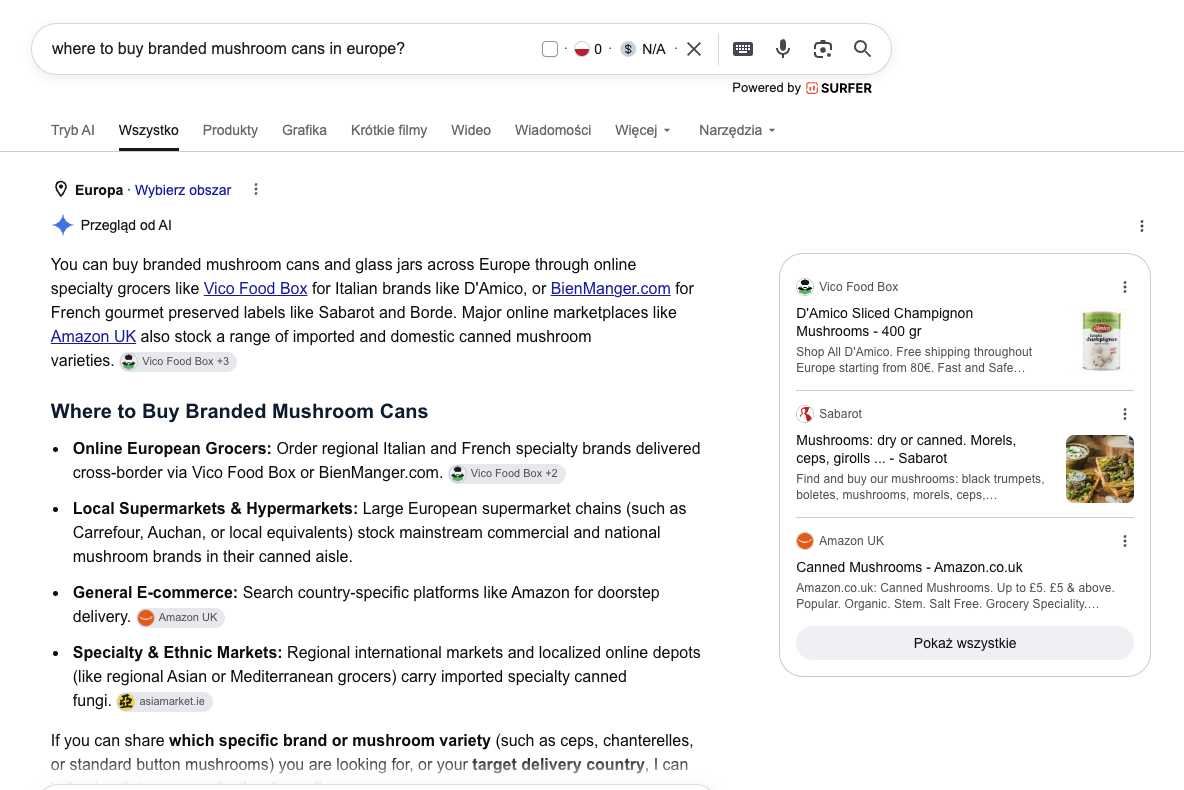
Language models, meaning ChatGPT, Perplexity, or Gemini, do not build their answers solely based on link rankings. They crawl content, extract facts from it, and decide which brand to cite as a source or recommendation. What matters for this process is the frequency and context of mentions in credible, topical content, regardless of whether Google treats them as a ranking factor. AI models operate on a different principle: they cite what they actually see in the content, and a brand mentioned repeatedly in a credible context simply ends up in the generated answer more often. We cover this mechanism in more detail in our GEO guide.
Where do brand mentions work best?
A mention works best where a link would look unnatural, or where what matters is clean context rather than a click. Three situations where this is especially visible:
- An extensive link profile. A domain that already has hundreds of backlinks does not need more of them. It needs signals that the brand is part of a given niche. A mention delivers that without the risk of the profile starting to look purchased.
- Regulated industries. Finance, medicine, law: aggressive link building can be risky there, because Google looks more closely at unnatural patterns in YMYL content. A mention in an expert piece builds authority without that risk.
- Brand recognition, not just ranking position. SaaS and B2B, where a decision-maker reads an industry article before ever visiting the product page. A mention in the right context works at a stage where a link alone would not change anything yet.
How to evaluate whether a mention has value?
Not every mention strengthens a brand equally. Before committing to a specific publication, check four things:
- The portal's organic traffic. A mention on a site with no visitors is not crawled regularly, either by Google or by AI models.
- The article's topical relevance. A mention of a financial brand in a gardening article does not build context, it just dilutes it.
- Placement within the content. A mention in the opening paragraphs, in a natural recommendation context, carries more weight than one tacked on at the end as a list of names.
- The company it keeps. Check which other brands are mentioned in the same article or on the same portal. A mention next to credible names strengthens yours, next to random ones it does not.
The criteria for evaluating a mention are, in practice, identical to the ones we use to evaluate every portal before publication: traffic, topical relevance, indexing history, and a clean link profile.
Mention or link: which to choose?
The short rule: choose a link when the priority is traffic and directly supporting a target page's ranking for a specific phrase. Choose a mention when the priority is context and brand authority, and the link profile does not need another link, or the niche is too sensitive for aggressive link building.
In practice, the combination of both works best: regular links supplemented with mentions that diversify the profile and build recognition where a link alone would not change anything. I have laid out concrete scenarios and a decision table in a separate piece: mention or link, which to choose.
A mention is a different way to build authority, not a plan B for a link
A brand mention is not a worse version of a link, it is a different instrument with a different function. A link passes on traffic and strengthens the target page. A mention builds context around the brand: the entity that Google describes in the Knowledge Graph, and the source that AI models actually cite in their answers. It does not replace links, but it strengthens what a link alone cannot build.
If your link profile is already extensive, or you operate in a niche where every additional link has to be chosen with surgical precision, mentions are the natural next step. See which portals in our network your brand could appear on.