Informational article
Spread, commission, and swap points — where to check your trading costs
In preparation
We identify the firm, instrument, and market before selecting a portal. Campaigns keep CFD product information separate from platform functionality, costs, and order execution.
54
finance and business portals
2
content paths
12 mo.
indexation monitoring
Finance & Business
Financial portal
Publication topic
CFD on currencies vs. buying currency — what's the difference?
Portal database
We do not select portals on metrics alone. The first question is whether the article concerns the instrument and its risks, or the operational side of the platform. Financial and business portals handle these questions differently.
46
finance sites
8
economics sites
2
communication paths
12 mo.
indexation monitoring
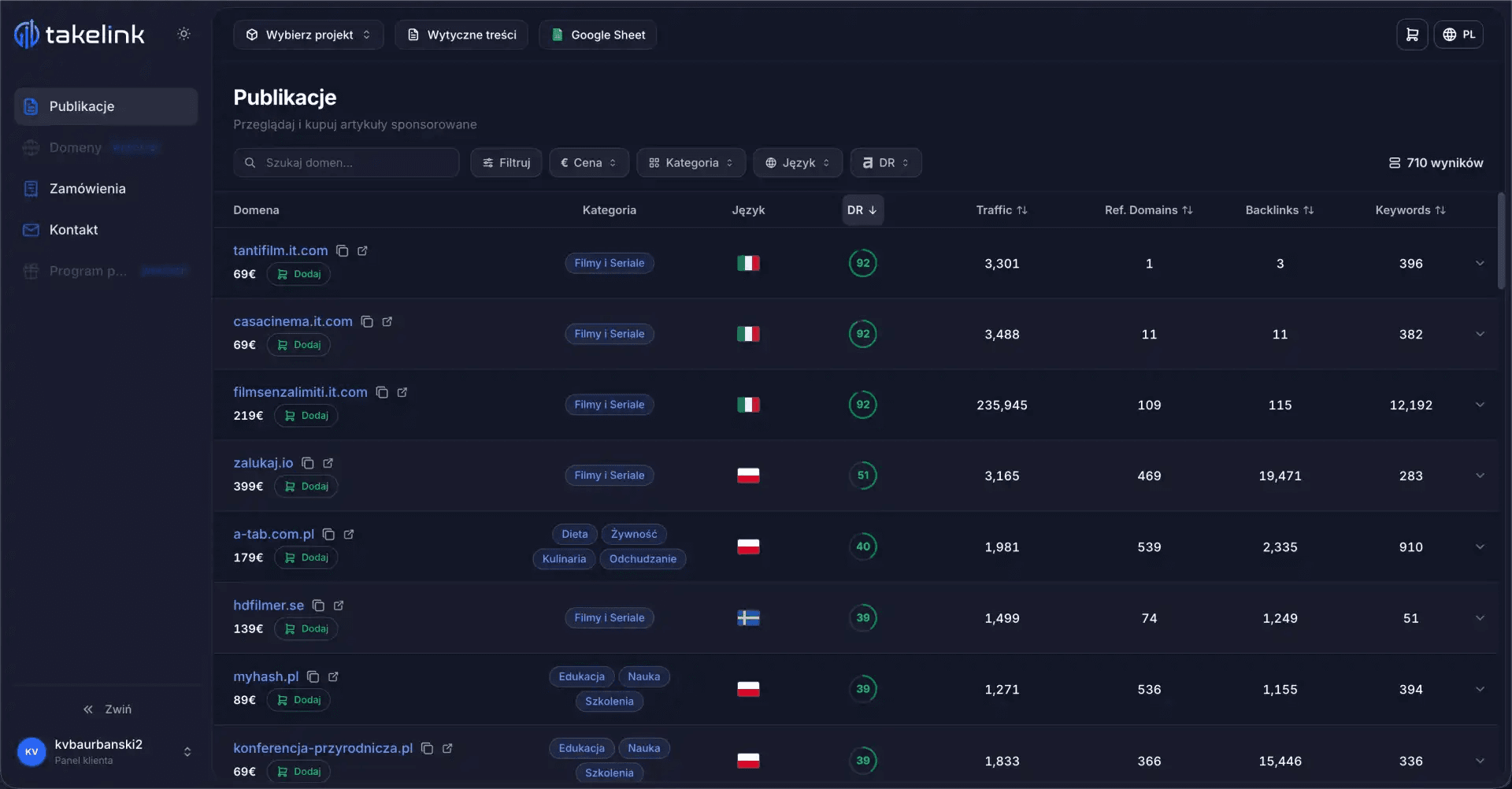
Portal selection criteria
We never select portals based on a single metric alone.
Collaboration paths
The first path helps users understand who they are contracting with and what the product actually is. The second covers how the platform operates. Neither path contains investment advice or promises of returns.
Path 01
Sample topics
Path 02
Sample topics
Packages
Scope depends on the number of instruments, platform features, and ready-to-use landing pages. We do not write articles until the relevant product documents are current and linkable.
Single product and market
An initial series covering one instrument group, client category, and market version of the platform.
Lower unit cost
Pricing after portal selection
Instrument and platform
Separate content streams covering product status and risk alongside platform costs and operational guidance.
Lower unit cost
Pricing after portal selection
Platform portfolio
A plan spanning multiple instrument groups, platform features, documents, or markets — without forecasts or trading signals.
Lower unit cost
Pricing after portal selection
How it works
Send your brief
Tell us about the site, niche, target market and campaign goal. We'll use that to scope the work.
Site selection & pricing
We match sites to your topic, audience and budget, then send a proposal for your approval.
Content & approval
You can supply a ready article or ask us to write one — either way you sign it off before we publish.
Publication & monitoring
Once approved, we publish and start monitoring indexation.
What's included
Before launch, we create an entity, instrument, and source record. After publication, we deliver URLs and indexation monitoring.
Send a brief for one client — we'll come back with a portal proposal, role breakdown, and a rough timeline.
Important for this industry
Jak pracujemy
"Forex" is used interchangeably to describe the interbank currency market and retail derivative products. These are not the same thing. When a retail client gains exposure through a CFD, they are not purchasing the underlying currency or asset. Every article we produce names the actual product and explains how it works.
Before publication, the client confirms the investment firm, the relevant regulator, the legal basis for providing services in that market, and the scope of regulated activities. TakeLink does not verify authorisation on the client's behalf, but requires a current registry source and does not treat a regulator's logo as proof of authorisation for an entire corporate group.
CFD marketing aimed at retail clients requires a prominent risk warning and must reflect product intervention measures — including leverage limits, margin close-out rules, negative balance protection, and the prohibition on inducements. A product's commercial name does not exempt it from these requirements.
We separate content about the entity and instrument from content about the platform, costs, and order execution. Business and macroeconomic content is used solely to explain data sources and market concepts — not to provide rate forecasts, trading signals, or the appearance of a proven strategy.

Answers covering investment firm verification, CFD classification, risk warnings, costs, platform content, and publication logistics.
Forex and trading covers investment firms, derivative instruments, trading platforms, cost structures, and order execution. Financial services covers credit and lending. Crypto covers CASP-regulated services and blockchain. Each area has its own registries, risk frameworks, and required documentation.
No. In retail broker offerings, exposure to a currency pair is typically gained through a CFD, with no delivery of the underlying currency. That is why we confirm the actual instrument before writing a single line of content.
We need the legal entity name, market, regulator, registry entry, scope of regulated services, client categories, instrument list, and pages containing the relevant documents. The client confirms that all information is current and correctly interpreted.
No. We do not create recommendations, signals, strategies, or forecasts of any kind. Content explains the product, its documentation, costs, risks, and platform features.
A commercial product name does not determine regulatory classification. ESMA indicated in 2026 that certain leveraged perpetual contracts may fall within the CFD definition. The client must confirm the classification of each specific product and the applicable product intervention measures.
We explain the types of costs involved and direct readers to the current schedule or instrument specification. We do not present a variable spread as a fixed commitment, and we do not omit commission, swap charges, or other costs that are material to the topic.
For neutral topics covering data sources, central bank publications, and macroeconomic mechanisms. We do not use a macroeconomic context to build rate forecasts or transaction scenarios.
Yes. The client provides the current risk warning appropriate for the entity and the communication, approves how it is presented, and signs off on the complete article. The publisher independently confirms that it accepts the content.
We monitor each publication for 12 months. If an article is not indexed within 60 days, or drops out of the index, we source a comparable portal at no additional cost — and the replacement also goes through the full forex/CFD qualification process.
No. They can bring structure and clarity to content about the firm, instrument, and platform, but they do not guarantee Google rankings, AI citations, account sign-ups, or transaction performance.
Last updated: July 2026
Next step
Send us the entity details, market, instruments, registry entry, risk warning, cost schedule, and target pages. After qualification we will propose portals and topics.
See also