Informational article
How to maintain a domain registry across a client portfolio?
In preparation
We integrate into your agency's workflow as the link building fulfillment layer — not as the owner of strategy or the client relationship. Every account has its own brief, domain history, approval chain, and a report you can deliver under your own brand.
2000+
owned portals
24h
to first publication
12 mo.
indexing monitoring
White-label for agencies
Portal matching client brief
Publication topic
How to prepare data for client solution selection?
Portal database
A large network means nothing if you keep getting irrelevant pitches. From 2000+ portals across 30 categories, we filter only those that match your client's market, niche, and budget.
2000+
owned topical sites
946 sites with ≥100 visits/mo.
30+
topic categories
within 24h
first publication
12 mo.
indexation monitoring
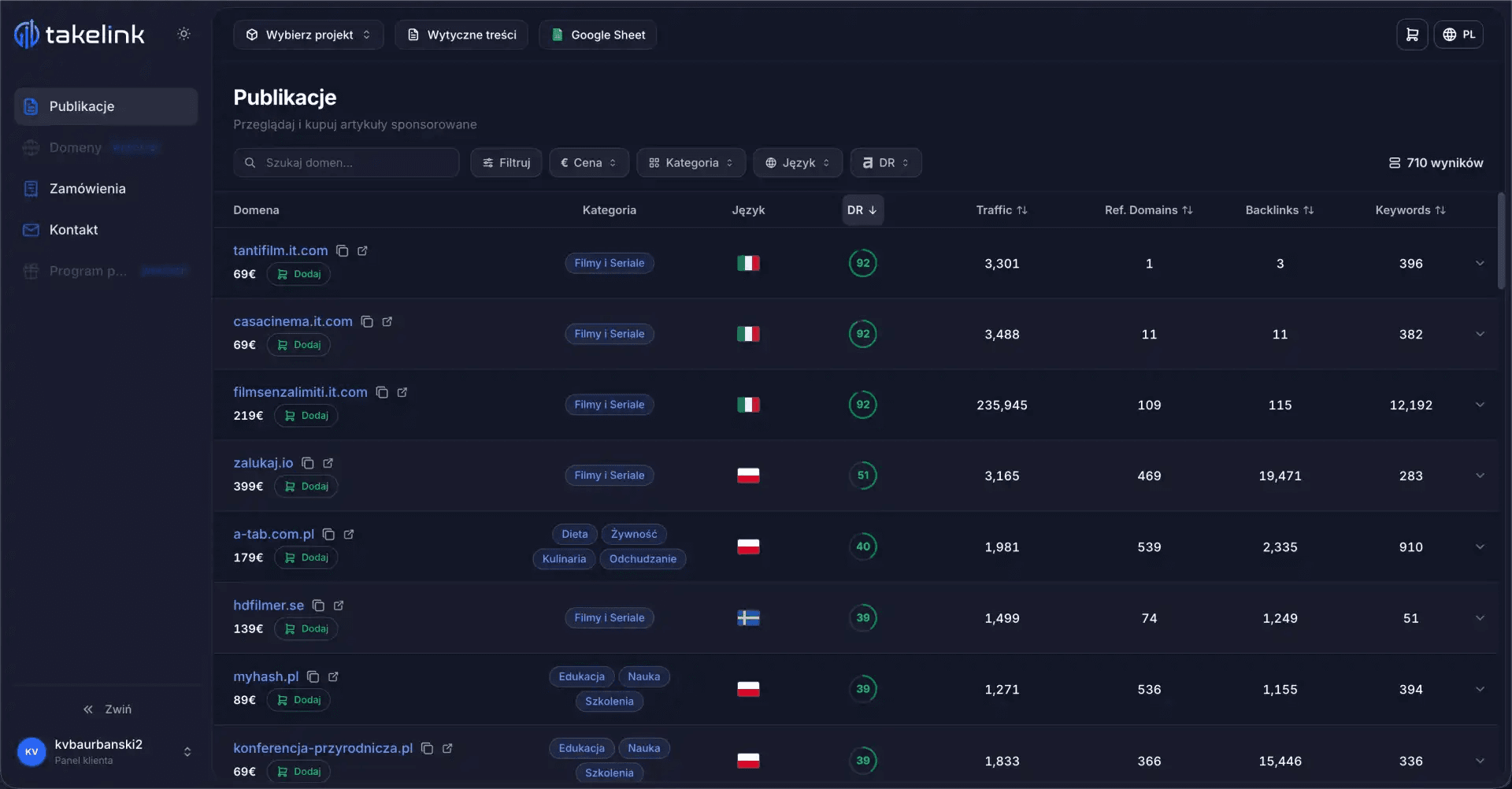
Portal selection criteria
We never select portals based on a single metric alone.
Collaboration paths
Not every SEO agency enters white-label link building at the same stage. You can test us on one client or hand over your entire portfolio from day one — choose the path that matches where you are right now.
Path 01
Sample topics
Path 02
Sample topics
Packages
The scope can cover a pilot, several active accounts, or a steady recurring queue. Publication allocation across clients is transparent and can only change after agency confirmation.
Process Pilot
A controlled scope for a single client or category — used to validate the brief, approval workflow, and report standard.
Lower unit cost
Pricing after portal selection
Active Portfolio
Scope for several accounts with separate briefs, budgets, domain histories, and decision schedules.
Lower unit cost
Pricing after portal selection
Ongoing Fulfillment
A recurring queue for a larger portfolio — after a successful pilot and agreed exceptions, responsibilities, and close-out cadence.
Lower unit cost
Pricing after portal selection
How it works
Send your brief
Tell us about the site, niche, target market and campaign goal. We'll use that to scope the work.
Site selection & pricing
We match sites to your topic, audience and budget, then send a proposal for your approval.
Content & approval
You can supply a ready article or ask us to write one — either way you sign it off before we publish.
Publication & monitoring
Once approved, we publish and start monitoring indexation.
What's included
We do not hand over just a URL. We document the inputs, decisions, status, proof of publication, and monitoring terms your team needs to service the client.
Send a brief for one client — we'll come back with a portal proposal, role breakdown, and a rough timeline.
Important for this industry
Jak pracujemy
White label does not mean an anonymous link package. Before we start, we define what stays on the agency side, what TakeLink handles, who approves topics and copy, whether we can contact the end client directly, and what data may appear in the report. Without that boundary, a vendor can slip into your client relationship — and your account manager loses clarity on what they're accountable for.
Every order has its own project code, market, industry, and domain history. The domain registry lets you check whether a given domain has already been used for another client. This is not a rigid 'one domain, one client' rule — decisions are always made in context, never automatically.
Commercial publication must comply with search engine guidelines and publisher terms. That is why we confirm format and available link attributes before an order is placed. We do not sell promises of 'safe dofollow' or immunity from algorithm updates.
Scale is the result of operational control, not the number of rows in a spreadsheet. That is why we start with a pilot on a single account and only then build a queue for multiple clients.

Answers on role division, confidentiality, link attributes, domain history, approvals, turnaround times, monitoring, and reporting.
The agency retains the brand, strategy, client contact, and billing relationship. TakeLink handles the agreed portal selection, content, publication, and reporting — without independently taking over the end-client relationship.
The agency does. We can supply data, proposals, and execution — but the agency knows the full audit, the risk profile, the contract, and the client's goals, and it approves how each publication fits the strategy.
Not always. Many engagements run on a project code, a public-facing URL, an industry category, a market, and source materials. We agree on the data scope based on operational need, conflict checks, and required verification.
Only if the agency explicitly sets up that model and defines the scope. By default, all questions, approvals, reports, and escalations go through the designated contact on the agency side.
The owner named in the project brief. Agency-side approval is standard; an additional client-side approval layer is possible, but the sequence, deadlines, and revision scope are agreed before work begins.
We do not make a blanket promise. Conditions depend on the publisher and are confirmed before the order is placed. Google recommends rel="sponsored" or rel="nofollow" for paid links and treats links created primarily to manipulate rankings as spam.
Yes — if the context, strategy, and exclusions allow it. The domain registry surfaces prior usage so every decision is informed, not driven by a gap in history.
Within 24 hours of scope confirmation, provided the brief, content, approval, and selected portal are all ready. The schedule for subsequent publications depends on individual publishers and agency decisions.
We track indexing of the published URL. If the content is not indexed within 60 days, or drops from the index within 12 months, we move it to a comparable portal at no additional cost.
No. Google does not guarantee indexing or ranking, and there is no special markup that ensures inclusion in AI-generated results. Outcomes depend on the full site, competition, and search engine policies — not publication volume alone.
Last updated: July 2026
Next step
Send us an anonymized brief, target URL, market, exclusions, and your approval standard. We will map out the pilot before planning fulfillment for your full portfolio.
See also