Informational article
What documents do businesses need to apply for financing?
In preparation
We build separate content tracks for consumer financing and business lending. Drawing on 80 finance, legal, and business portals, we match every topic to the right product and a complete set of required disclosures.
80
portals across 3 contexts
2
financing tracks
12 mo.
indexation monitoring
Finance, Legal & Business
Finance portal
Publication topic
APR vs. interest rate — what's the difference and why it matters
Portal database
We do not select portals based on a generic 'finance' label. We ask whether the topic relates to a consumer product, contractual obligations, or business financing — and we match the context accordingly: a finance portal, a legal portal, or a business portal.
46
finance sites
26
law & tax sites
8
economics sites
12 mo.
indexation monitoring
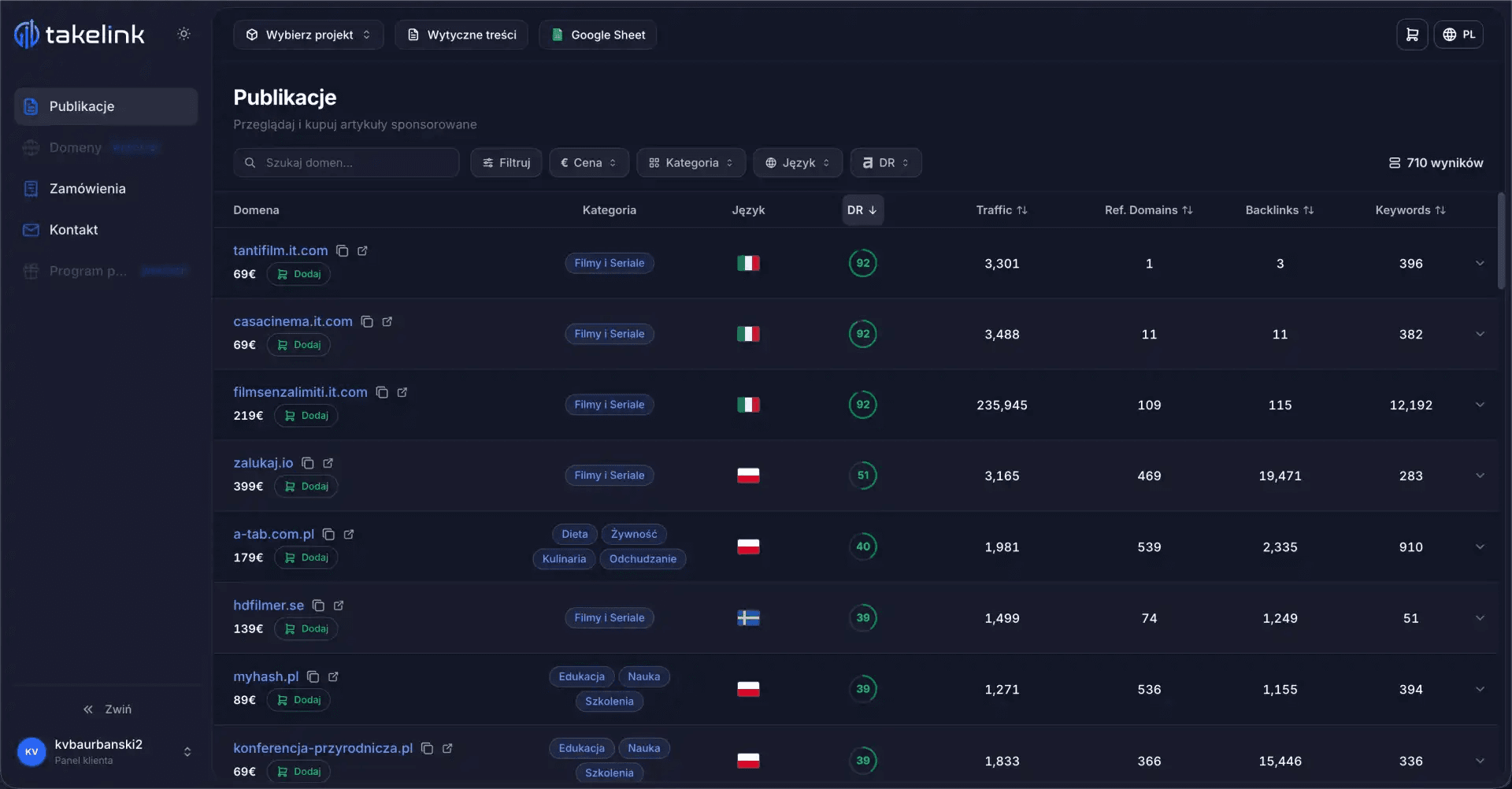
Portal selection criteria
We never select portals based on a single metric alone.
Collaboration paths
We never carry cost language, examples, or documentation requirements across the B2C and B2B divide. Each track gets its own questions, client materials, and destination page.
Path 01
Sample topics
Path 02
Sample topics
Packages
The scope can cover a single product, separate B2C and B2B tracks, or multiple financing products. We do not duplicate links to the same product category without a distinct search intent and a separate landing page.
Single Product
An initial link building run for one consumer product or a single business financing solution.
Lower unit cost
Pricing after portal selection
Consumer & Business
Two separate publication tracks — one for B2C offers and one for business financing.
Lower unit cost
Pricing after portal selection
Financing Portfolio
A full plan covering multiple products, customer segments, or several stages of the decision journey.
Lower unit cost
Pricing after portal selection
How it works
Send your brief
Tell us about the site, niche, target market and campaign goal. We'll use that to scope the work.
Site selection & pricing
We match sites to your topic, audience and budget, then send a proposal for your approval.
Content & approval
You can supply a ready article or ask us to write one — either way you sign it off before we publish.
Publication & monitoring
Once approved, we publish and start monitoring indexation.
What's included
Before launch we align on entities, products, current cost sources, and landing pages. After each publication you receive the live URL and we activate indexation monitoring.
Send a brief for one client — we'll come back with a portal proposal, role breakdown, and a rough timeline.
Important for this industry
Jak pracujemy
The starting points are cost, terms, documentation, application assessment, and the role of the lender or intermediary. Fintech, investing, forex, crypto, and insurance have separate search intents and separate campaigns.
Consumers need clear information about total cost, APR, repayment schedules, terms, and their rights. Businesses tend to ask about the purpose of the financing, required documentation, collateral, the assessment timeline, and cash-flow impact.
When consumer credit content includes cost figures, the client supplies the full required dataset and approves how it is presented. A sponsored article does not replace a product advertisement, a pre-contractual information form, or an individual credit assessment.
The client states their role, the relevant register or legal basis, the scope of the product, and the approval workflow. We verify that the topic, portal, and landing page are consistent with the materials provided — we do not issue legal opinions or confirm authorisation to conduct regulated activities.

Answers about links for loans, credit products, intermediaries, and business financing — and about the campaign approval process.
Financial services covers financing, cost, terms, documentation, and the product agreement process. Fintech focuses on the application layer, payments, technology infrastructure, and API integrations. Keeping them separate prevents topic cannibalisation and ensures each link points users to the right destination.
Yes — but as two entirely separate tracks. Each has its own questions, source materials, portals, and landing pages. We never carry a consumer cost example or consumer communication rules across to a B2B offer.
We need the product type, target audience, entity role, market, current terms and cost data, a representative example, required regulatory disclosures, and the approved product page. The full dataset and its presentation must be signed off by the client.
Yes, provided the client supplies the current complete dataset required for that communication and approves how it is presented. We do not publish a single attractive figure lifted out of the full product terms.
The most common topics cover the purpose of different financing structures, how to prepare required data, the stages of the assessment process, the roles of each party, and high-level differences between financing mechanisms. The content does not replace a company-specific analysis or guarantee any outcome.
The client identifies the relevant register, their regulatory status, and the legal basis for their activity — and is responsible for keeping that information current. TakeLink may reference the provided source within the content process, but we do not issue legal opinions or verify authorisation to conduct regulated activities.
A legal portal is chosen when the topic genuinely involves contractual obligations or regulatory requirements. A business portal is used when the topic centres on company operations or business financing. Neither is used as a catch-all substitute for a specialist finance publication.
Yes. We establish a named approver or approval team for the topic, product data, cost figures, link placement, and final copy. Content only goes to the editorial team after passing the agreed approval process.
We monitor indexation for 12 months. If an article is not indexed within 60 days, or drops from the index during that period, we move it to a comparable portal at no additional cost, in line with the service terms.
No. They can help establish a clear brand and product context across external sources, but they do not guarantee Google rankings, citations in AI-generated responses, credit approval decisions, or any specific volume of enquiries.
Last updated: July 2026
Next step
Share your product type, target audience, entity role, market, and a live page with current terms. We'll prepare a topic and portal proposal for your review.
See also