
For years, briefs for sponsored articles all looked the same: insert a link, pick an anchor, done. That model worked as long as the only reader of the content was a crawler counting links. Today, a second reader has joined it: a language model that does not count links, it reads sentences and remembers how the brand was described. That changes a lot more than it might seem.
What did link building look like before AI started reading content?
The whole idea behind link building came from a single assumption that Larry Page and Sergey Brin wrote into the 1998 PageRank patent: a link from one page to another is a kind of vote of confidence, similar to one academic paper citing another. The more such votes a page collected, and the more credible the pages casting them were, the higher it ranked. That assumption, not any marketing decision, is what launched the entire link building industry.
From that point on, the approach to linking shifted several times, always in response to how the industry started abusing the previous model:
- 1998, PageRank. Google starts counting links as votes of confidence. Within a few years, an entire industry of directories, link exchanges, and link farms springs up, because a page with more inbound links simply won.
- 2005, the nofollow attribute. Google, Yahoo, and Microsoft jointly introduce nofollow to curb spam in blog and forum comments, the first major attempt to distinguish an earned link from one dumped in en masse.
- 2012, the Penguin update. Google starts penalizing sites for massive, unnatural link profiles and shifts the evaluation toward quality and topical relevance of links, not their sheer number.
- 2014, the end of mass guest blogging. Matt Cutts, then head of Google's webspam team, writes plainly that it needs to stop, because the tactic is collapsing under the weight of spammy publication requests. This does not end guest publications as such, but it does end the era in which the mere fact of being published anywhere at all was enough.
Each of these shifts moved in the same direction. Google evaluated links ever more precisely, their origin, context and topical relevance, but it was still evaluating links, not the sentences surrounding them. Content was the vehicle, judged through the lens of link metrics: domain authority, anchor text, placement. How precisely the brand description was worded did not matter much to an algorithm counting inbound links.
This changed only with the arrival of language models, which do not count links at all. They read sentences and cite what is actually written in them.
What actually changed: the mechanics, not the slogan
Models like ChatGPT or Perplexity mostly do not work like a search engine counting links. The key distinction: the base ChatGPT model answers from memory, limited by its training data cutoff date. But search mode (ChatGPT Search) and Perplexity by default run a live web search: they pull in anywhere from a few to a dozen or so pages, filter them, and build an answer based on the fragments that best match the question. This process is called RAG (retrieval-augmented generation).
In practice, it looks like this: Perplexity retrieves around 10 pages per query on average, but cites only 3–4 of them in the final answer, the ones from which a specific claim can be precisely extracted and attributed, not the ones with the highest domain authority. That is why Ahrefs, analyzing 15,000 queries, found only 12% overlap between the URLs cited by AI assistants and Google's top 10 results. The rest of the citations come from pages that would not even make it to the first page in classic search.
What determines citability is not domain authority alone, it is whether a specific, ready-to-cite sentence can be pulled from the page. A generic brand description, “great service” or “recommended place”, gives the model nothing to work with. A specific formulation, with a name, a context of use, and a clear takeaway, is repeated by the model almost verbatim, because that is exactly the kind of sentence it builds its answer from.
Case study: one sentence ChatGPT still repeats today
This is best seen in an example we observed within our own team. Bartosz was preparing content about the restaurant Stella Maris and added one sentence to it: that it is worth going there for a romantic dinner if you want something in a more restaurant-style presentation. Nothing elaborate, just a specific description of a specific situation.
A week later, ChatGPT, when asked about restaurants for a romantic dinner in the area, started answering with almost the exact same phrase: to choose Stella Maris if you want a romantic dinner in a more restaurant-style format. The model did not come up with this on its own, it repeated, word for word, the phrasing someone had written for it earlier.
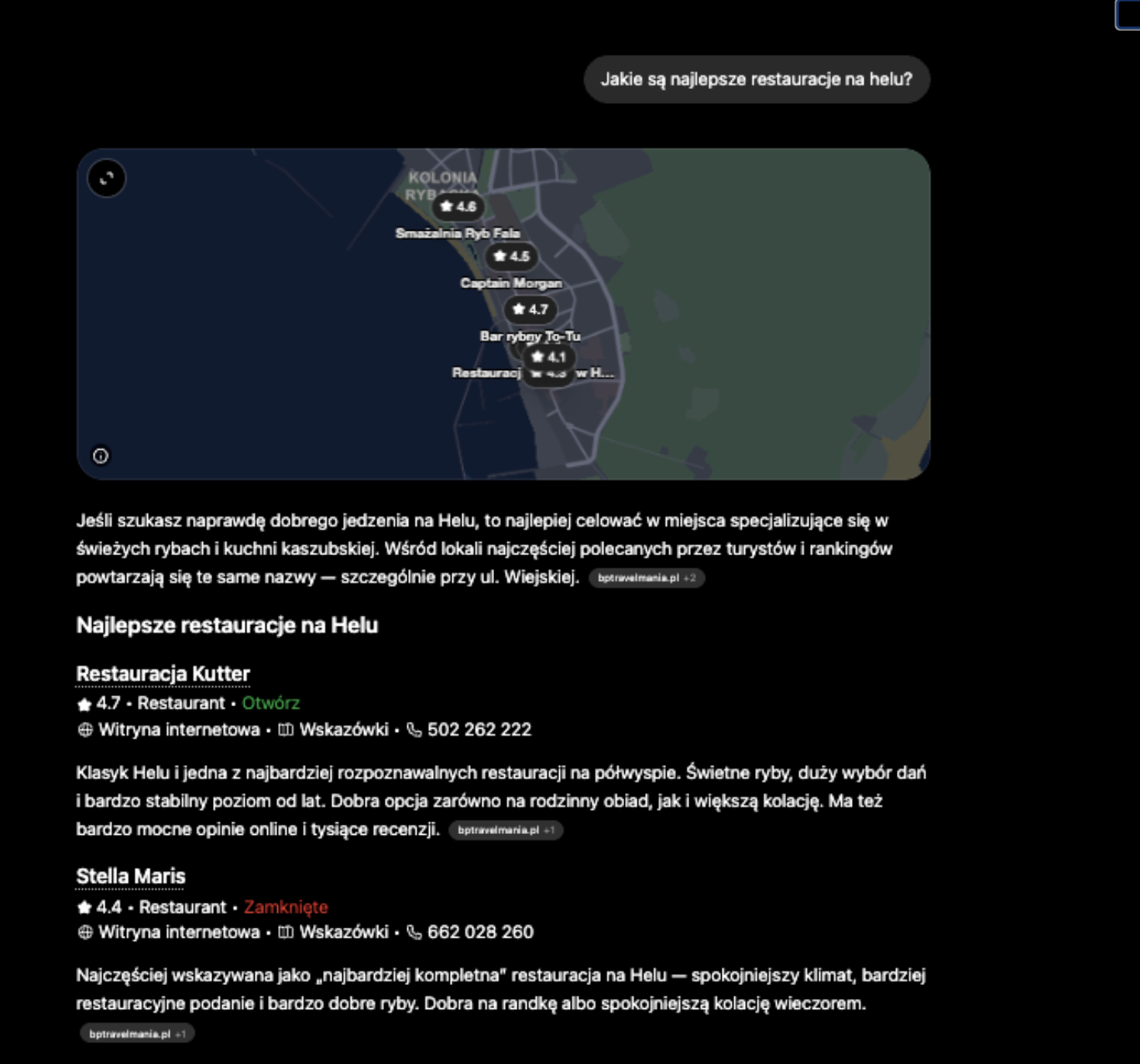
This is not an isolated case or a lucky coincidence. It shows the mechanism at work whenever content about a brand is specific enough for the model to have something to repeat.
The Stella Maris case shows the mechanism, but it does not limit the topic to a single format. The brand context that AI later cites can be built in several ways, and which one you choose depends mainly on the stage the brand is at.
A new domain that is still building authority needs a sponsored article with a link and well-described context, exactly like in the example above. A brand with an already extensive link profile will more often benefit from a mention, because another link might not add much, while a specific sentence about the brand still gives the model material to cite. There are also in-between situations: a link in an existing article on a portal that already has traffic and indexing, where speed matters more than creating content from scratch.
Which format to choose is something I covered in more depth in the article on choosing between a link and a mention. What matters here is just that each of these, done well, gives the model the same thing: a specific sentence that can be cited.
How to approach link building today so it works twice as hard
Now that you know how the mechanism works, it is worth changing the way you think about why you are even ordering another publication in the first place. It is no longer just about getting one more link to your profile, it is about leaving behind a sentence that someone, a person or a model, will be able to repeat later. If you treat a publication purely as a “link for money” transaction, you are using maybe half of what well-written content offers today.
In practice, this means a few concrete changes to how you brief and approve content:
- Instead of a generic compliment, describe a specific use case. “Great place for a date” gives the model nothing to remember. “Perfect for a romantic dinner in a more elegant, restaurant-style setting” already does.
- Repeat the same phrasing across several publications, instead of a different one each time. A model reaches for a formulation it has seen repeatedly in similar wording more often than one that appeared just once.
- Avoid purely promotional language. Sentences that read like a recommendation rather than an ad headline have a better chance of being treated as a credible source.
- Place the key sentence within the body of the article, not just in a closing summary. The model pulls fragments from across the whole text, but a sentence tucked away where few readers ever reach has less chance of being noticed at all.
The effect of this approach is twofold: the link still builds the page's authority in classic SEO, while the specific sentence around it starts to live a life of its own in AI answers, sometimes long after you have forgotten about the publication itself.
Context around the brand is a new element of link building, not an add-on
We have covered some ground today: from PageRank counting links like votes, through successive updates penalizing the mere existence of a link with no content behind it, to models that do not count links at all, they read sentences. Each of these stages required the same thing: adapting to whatever the system you are working with actually evaluates.
Today that system is also AI, alongside Google. You can match the format to the situation, as shown above: a link, a mention, or both. What does not change regardless of format is the quality of the sentence itself that you are ordering. Start with a brief that describes the brand specifically, not generically, and the rest will fall into place. Tell us what you are working on and we will suggest the format and the portals.